
During the last few years “The Trinity” has become much more to me than a theological belief, but also a symbol of divine unity and spiritual wholeness. Today, I share insights about the Trinity as portrayed in a 15th century icon called The Trinity. It may give you some food for thought.
“To believe and love the Trinity is to possess the key of theology.”
Charles Spurgeon
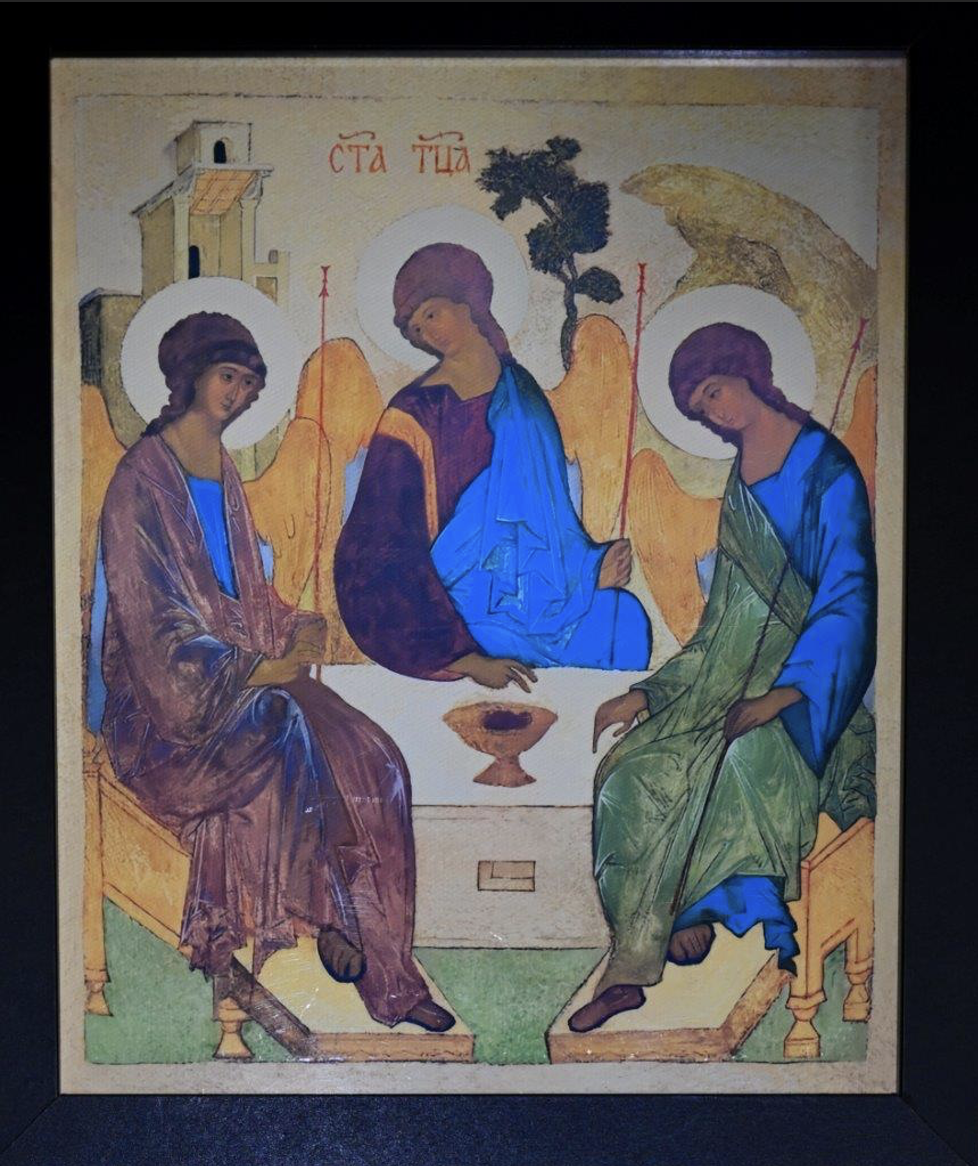
This photo of a 15th Century icon speaks to my soul. The Trinity was painted by the iconic Russian artist, Andei Rublev, in the 15th Century. The icon subject is from the biblical story when Abraham extends hospitality to three visitors by the oak of Mamre and is a metaphor for the three persons of the Trinity.
The Trinity is one of those theological mysteries. Of this mystery, Eugene Peterson, (1932-2018), Presbyterian minister, theologian, and author of The Message, said.
“It is commonly said that the Trinity is a mystery. And it certainly is … But it is not a mystery veiled in darkness…. It is a mystery in which we are given to understand that we will never know all there is of God …. It is not a mystery that keeps us in the dark, but a mystery in which we are taken by the hand and gradually led into the light ….” Christ Plays in Ten Thousand Places
There is much symbolism In Rublev’s painting, and I will only skim the surface. The three figures form an open circle. The figure on the left represents God the Father, the figure in the center God the Son, and the one on the right God the Spirit.
The opening suggests there’s a place for you or me, welcoming us into a divine relationship of unity, peace, and mutual love. Could it be an invitation to pull up a seat and learn from the blessed, Holy Trinity? I wonder.
Charles Spurgeon (1834-1892), an English Particular Baptist minister, whose prolific writings continue to influence Christians, was known as the “Prince of Preachers,” and he often spoke of the Trinity, saying,
“There is a mutual delight in each other in the persons of the blessed Trinity, so that each divine person delights to glorify the rest …. ”
Concerning the Trinity, Augustine of Hippo (354-430), an influential Christian theologian and Bishop from Roman Africa, said,
“For to have the fruition of God the Trinity, after whose image we are made, is indeed the fullness of our joy, then which there is no greater.”
Each member of the Trinity is distinctive in personality and function, even as each person who dwells on planet earth is a unique individual. Nevertheless, there is oneness, harmony, and mutual respect, exemplifying perfect community. St.Teresa of Ávila (1515-1582), Spanish mystic, Carmelite nun, and religious reformer, explained,
“The three Persons are distinct from one another; a sublime knowledge is infused into the soul, imbuing it with a certainty of the truth that the Three are of one substance, power, and knowledge and are one God.”
The reason I have chosen to place Rublev’s icon on a shelf in my office is to remind me that the Holy Trinity is the perfect symbol of “Wholeness,” my guiding word for 2026.
I close today with an intimate quote from Catherine of Siena (1347-1380), an Italian mystic and prominent laywoman who influenced national and Church politics through extensive letter-writing and advocacy.
“You, oh eternal Trinity, are a deep Sea, into which the deeper I enter the more I find, and the more I find the more I seek.”
Blessings on your journey!
